

[ WHERE GOVERNANCE MEETS OPERATIONS ]
Drone-enabled operations you can defend
Echo Two helps public-safety agencies build drone programs that are accountable in the field, defensible under scrutiny, and designed to last. The same operating model applies across infrastructure, field operations, and training.
How We Work
One operating model. Four layers.
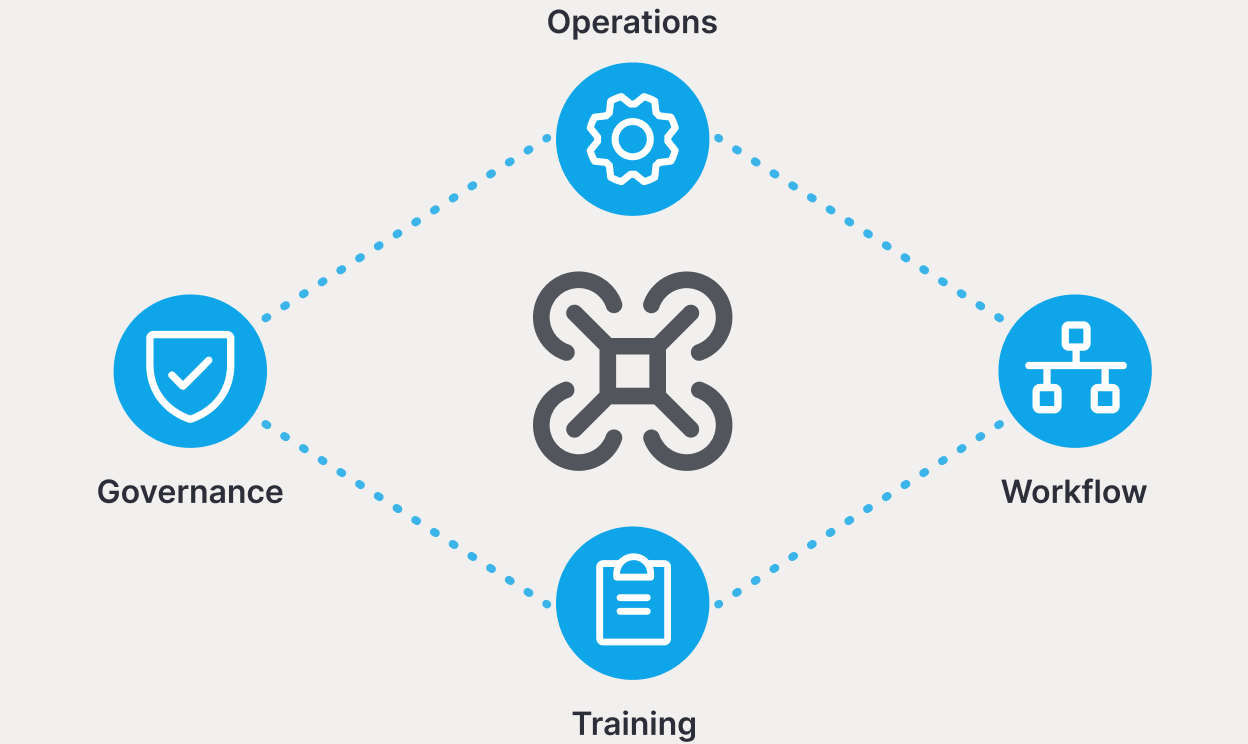
Getting airborne is the easy part. Sustaining operations under scrutiny requires technology, governance, trained people, and workflows that hold up when the pressure is real. Echo Two connects those layers from initial interest to operational capability.

Technology & Integration
We integrate aircraft, sensors, software, and mission systems so the tools fit the operation, not the other way around.

Governance
We build the policies, approvals, privacy rules, evidence practices, and audit-ready documentation that let you operate responsibly and withstand review.

Workflows
We design the staffing models, launch procedures, dispatch coordination, training rhythms, and day-to-day practices that turn drone capability into reliable, repeatable operations.

Intelligence
We turn mission data into reporting and decision support that gives supervisors and administrators the visibility to act and the documentation to defend their decisions.
[ CURRENT CHALLENGES ]
Aircraft is the easy part
Any agency can buy a drone. The harder work is building an operation that is safe, trusted, repeatable, and useful when the pressure is real.
For DFR, that means more than putting an aircraft in the air. It means knowing when it launches, who controls it, how information flows, how privacy is protected, how evidence is handled, and how the program is defended after the mission.
Most programs stall because the operating system around the aircraft is never finished.
Common friction points:

Unclear policy and approval paths

Privacy exposure and evidence chain gaps

Limited staffing or training capacity

Unclear reporting for admins, staff, or councils

Disconnected tools and dispatch workflows

Community scrutiny with no communication strategy

[ OUR SERVICES ]
Disciplined operations. Built to be trusted.
Public Safety
Commercial & Infrastructure
Training & Readiness
Public safety agencies use Echo Two to build response, overwatch, and DFR programs that are safe, accountable, and built to last.
Explore Public Safety

[ THE ECHO TWO DIFFERENCE ]
Most drone programs are built around equipment. Ours are built around outcomes.
Traditional Operations
Most drone support leads with equipment, hardware, one-time training, and flight hours.
- Focused on launch
- Pilot-dependent
- Training as a one-time event
- Policy handled after purchase
- Data disconnected from decision-making
- Hard to explain to councils or community
- Focused on launch
Echo Two
We start with asking who needs to use it, what decisions it supports, what rules it must follow, what data it creates, and how the program matures over time.
- Operations-first
- Workflow-driven
- Training as program capability
- Governance built into the design
- Reporting designed for command and administrators
- Built to be accountable and defensible
- Built to mature over time
Tell us what you’re building
Whether you are trying to build, improve, or evaluate, we will help you identify the next responsible step.
Start a Conversation
[ WHERE GOVERNANCE MEETS OPERATIONS ]
Drone-enabled operations you can defend
Echo Two helps public-safety agencies build drone programs that are accountable in the field, defensible under scrutiny, and designed to last. The same operating model applies across infrastructure, field operations, and training.
How We Work
One operating model. Four layers.
Getting airborne is the easy part. Sustaining operations under scrutiny requires technology, governance, trained people, and workflows that hold up when the pressure is real. Echo Two connects those layers from initial interest to operational capability.
Technology & Integration
We integrate aircraft, sensors, software, and mission systems so the tools fit the operation, not the other way around.
Governance
We build the policies, approvals, privacy rules, evidence practices, and audit-ready documentation that let you operate responsibly and withstand review.
Workflows
We design the staffing models, launch procedures, dispatch coordination, training rhythms, and day-to-day practices that turn drone capability into reliable, repeatable operations.
Intelligence
We turn mission data into reporting and decision support that gives supervisors and administrators the visibility to act and the documentation to defend their decisions.
[ CURRENT CHALLENGES ]
Aircraft is the easy part
Any agency can buy a drone. The harder work is building an operation that is safe, trusted, repeatable, and useful when the pressure is real.
For DFR, that means more than putting an aircraft in the air. It means knowing when it launches, who controls it, how information flows, how privacy is protected, how evidence is handled, and how the program is defended after the mission.
Most programs stall because the operating system around the aircraft is never finished.
Common friction points:
Unclear policy and approval paths
Privacy exposure and evidence chain gaps
Limited staffing or training capacity
Unclear reporting for admins, staff, or councils
Disconnected tools and dispatch workflows
Community scrutiny with no communication strategy
[ OUR SERVICES ]
Disciplined operations. Built to be trusted.
Public Safety
Commercial & Infrastructure
Training & Readiness
Public safety agencies use Echo Two to build response, overwatch, and DFR programs that are safe, accountable, and built to last.
Explore Public Safety

[ THE ECHO TWO DIFFERENCE ]
Most drone programs are built around equipment. Ours are built around outcomes.
Traditional Operations
Most drone support leads with equipment, hardware, one-time training, and flight hours.
- Focused on launch
- Pilot-dependent
- Training as a one-time event
- Policy handled after purchase
- Data disconnected from decision-making
- Hard to explain to councils or community
- Focused on launch
Echo Two
We start with asking who needs to use it, what decisions it supports, what rules it must follow, what data it creates, and how the program matures over time.
- Operations-first
- Workflow-driven
- Training as program capability
- Governance built into the design
- Reporting designed for command and administrators
- Built to be accountable and defensible
- Built to mature over time
Tell us what you’re building
Whether you are trying to build, improve, or evaluate, we will help you identify the next responsible step.
Start a Conversation

[ WHERE GOVERNANCE MEETS OPERATIONS ]
Drone-enabled operations you can defend
Echo Two helps public-safety agencies build drone programs that are accountable in the field, defensible under scrutiny, and designed to last. The same operating model applies across infrastructure, field operations, and training.
How We Work
One operating model. Four layers.
Getting airborne is the easy part. Sustaining operations under scrutiny requires technology, governance, trained people, and workflows that hold up when the pressure is real. Echo Two connects those layers from initial interest to operational capability.
Technology & Integration
We integrate aircraft, sensors, software, and mission systems so the tools fit the operation, not the other way around.
Governance
We build the policies, approvals, privacy rules, evidence practices, and audit-ready documentation that let you operate responsibly and withstand review.
Workflows
We design the staffing models, launch procedures, dispatch coordination, training rhythms, and day-to-day practices that turn drone capability into reliable, repeatable operations.
Intelligence
We turn mission data into reporting and decision support that gives supervisors and administrators the visibility to act and the documentation to defend their decisions.
[ CURRENT CHALLENGES ]
Aircraft is the easy part
Any agency can buy a drone. The harder work is building an operation that is safe, trusted, repeatable, and useful when the pressure is real.
For DFR, that means more than putting an aircraft in the air. It means knowing when it launches, who controls it, how information flows, how privacy is protected, how evidence is handled, and how the program is defended after the mission.
Most programs stall because the operating system around the aircraft is never finished.
Common friction points:
Unclear policy and approval paths
Privacy exposure and evidence chain gaps
Limited staffing or training capacity
Unclear reporting for admins, staff, or councils
Disconnected tools and dispatch workflows
Community scrutiny with no communication strategy
[ OUR SERVICES ]
Disciplined operations. Built to be trusted.
Public Safety
Commercial & Infrastructure
Training & Readiness
Public safety agencies use Echo Two to build response, overwatch, and DFR programs that are safe, accountable, and built to last.
Explore Public Safety

[ THE ECHO TWO DIFFERENCE ]
Most drone programs are built around equipment. Ours are built around outcomes.
Traditional Operations
Most drone support leads with equipment, hardware, one-time training, and flight hours.
- Focused on launch
- Pilot-dependent
- Training as a one-time event
- Policy handled after purchase
- Data disconnected from decision-making
- Hard to explain to councils or community
- Focused on launch
Echo Two
We start with asking who needs to use it, what decisions it supports, what rules it must follow, what data it creates, and how the program matures over time.
- Operations-first
- Workflow-driven
- Training as program capability
- Governance built into the design
- Reporting designed for command and administrators
- Built to be accountable and defensible
- Built to mature over time
Tell us what you’re building
Whether you are trying to build, improve, or evaluate, we will help you identify the next responsible step.
Start a Conversation